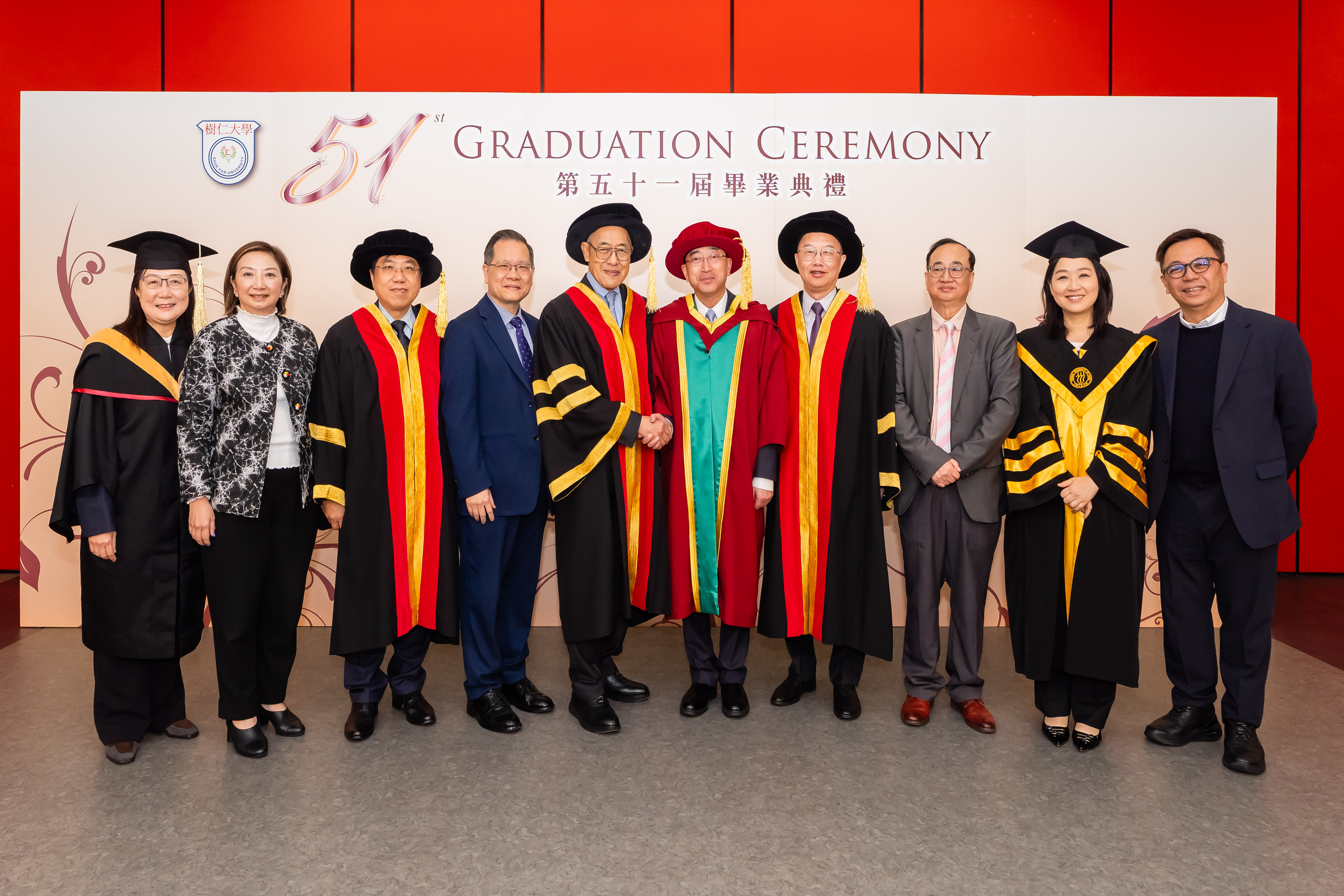
KO Wing-man Doctor of Social Sciences, honoris causa
A citation translated by Dr KUNG Chi-keung
Upon graduating from secondary school in the 1970s, Dr. KO Wing-man faced two potential paths as he entered university. He had a deep personal affinity for the humanities, particularly history and geography. Yet, like many of his academically gifted peers, he ultimately chose to study medicine at The University of Hong Kong. Was this decision driven by considerations of future prospects? Not at all.
As a young man, Dr. KO held a profound admiration for heroic figures from the late Qing and early Republican eras, most notably Dr. SUN Yat-sen and LU XUN. LU XUN, who abandoned his medical studies in favour of literature, believed that while medicine could alleviate physical suffering, the souls of the people remained deeply entrenched in millennia of feudal culture—an affliction not easily remedied. He therefore took up the pen to combat the ignorance of his compatriots. In contrast, Dr. SUN, a trained physician, sought to reshape the nation’s destiny through revolutionary action.
To Dr. KO, these were lofty ideals: noble, yet difficult to attain. He resolved to study medicine as a means of serving society. The healing of the human body is, in itself, a sacred calling. He held that only with physical well-being could individuals bear the weight of greater social responsibilities. Moreover, his illustrious medical career, shaped by rigorous training and an unwavering devotion to civic engagement, ultimately led him to pursue public service—a distinct yet equally impactful avenue for contributing to the community.
After earning his Bachelor of Medicine and Bachelor of Surgery (MBBS) from The University of Hong Kong in 1980, Dr. KO began his medical career at Princess Margaret Hospital, where he trained under an orthopedic surgeon and subsequently specialised in orthopedic medicine. In 1991, he joined the newly established Hospital Authority (HA), where he served as Director of Professional Services and Human Resources, marking the beginning of a distinguished career in healthcare administration.
During the SARS outbreak in 2003, Dr. KO assumed the role of Acting Chief Executive of the Hospital Authority at a critical juncture when the then-CEO, Dr. HO Siu-wai, was hospitalised after contracting the virus. In December of the following year, he stepped down from the Authority to establish his own orthopedic practice, continuing his commitment to patient care and public service.
From July 2012 to June 2017, Dr. KO served with distinction as Secretary for Food and Health, during which time he attained the highest public approval ratings among government officials in both 2013 and 2014. He subsequently returned to private medical practice and, in 2022, was appointed an Unofficial Member of the Executive Council of the Hong Kong Special Administrative Region. Over the years, he has remained steadfast in his service to both the government and the people of Hong Kong, and was awarded the Bronze Bauhinia Star in 2008 and the Gold Bauhinia Star in 2017, in recognition of his contributions.
Dr. KO has devoted his medical career to healing and service. Guided by the Confucian ideal of ‘education without discrimination,’ he embraces the principle of ‘medicine without distinction,’ treating patients regardless of age, background, or ethnicity. He provides care with wholehearted dedication, focusing solely on each patient’s needs and always placing their well-being first.
Healing and saving lives is Dr. KO’s lifelong mission. In addition to studying Western medicine, he has always evinced a deep interest in Traditional Chinese Medicine (TCM); and in 1996 he pursued part-time studies in TCM at the School of Professional and Continuing Education of The University of Hong Kong. His training encompassed foundational theory in TCM diagnostics and Chinese herbal medicine, and later included advanced subjects such as herbal pharmacology, gynecology, and pediatrics, all within the scope of Traditional Chinese Medicine.
Dr. KO’s interest in Traditional Chinese Medicine was inspired by his father, who previously managed a Chinese herbal pharmacy. He observed that the four diagnostic pillars of TCM—observation, listening, inquiry, and pulse reading—differ fundamentally from Western medical diagnostics. Believing that the two systems can complement each other to maximise clinical effectiveness, he became a strong advocate of integrative medical policy. He has vigorously championed Chinese- Western medical collaboration and played a pivotal role in facilitating the establishment of Hong Kong’s first Chinese medicine hospital.
A native of Chaozhou, Dr. KO deeply cherishes his cultural heritage, as reflected in his love of Chaozhou cuisine and the art of Gongfu tea. Within his private clinic, he has established a dedicated tea room where, during moments of leisure, he brews Phoenix Dancong Oolong tea for personal enjoyment. This aromatic infusion, cultivated on Chaozhou’s Phoenix Mountain, is renowned for its complex fragrance profiles, remarkable resilience to multiple infusions, and a sweet, lingering bouquet. These qualities mirror the essence of character: one must be resilient, able to ‘endure the brew,’ and generous in spirit to release one’s‘ full fragrance.’ His lifelong dedication to the nation, to society, and to his patients continues to exemplify the Chaozhou spirit of diligence, perseverance, solidarity, and selfless service.
In addition to his clinical work, Dr. KO enjoys birdwatching and often visits the countryside with his sons, who are also medical doctors, to observe the natural world. These moments of leisure and quiet contemplation demonstrate his appreciation for both the Confucian ideal of the gentleman’s life and the tranquil rhythms of Daoist living.
Mr. President, Dr. KO Wing-man’s professional ethos—healing with benevolence and living with integrity— resonates deeply with the values of our university, establishing him as a model for students to emulate. It is with the utmost respect, therefore, that I request you to confer upon Dr. KO the degree of Doctor of Social Sciences, honoris causa.
Source: March 2026 Issue